How to Write a Short Pet Story in 4–6 Lines (with Examples)
By the Share2Earn team · · 6 min read
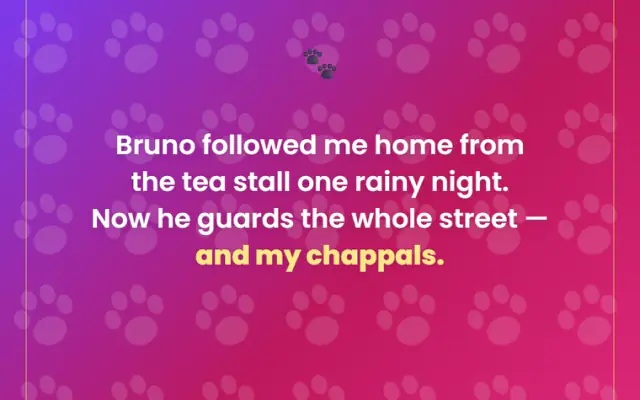
A short pet story only needs four to six lines to make a reader smile, laugh or feel a lump in the throat. You don't need to be a writer. You need one real moment with your pet, or with the street dog who waits outside your gate, and a few honest words. Here is a simple way to write a short pet story in Hindi, English or Hinglish, with examples to show how it works.
In this article
Pick one moment, not the whole life story
The most common mistake is trying to fit ten years into six lines. “Moti came to us in 2015, he loves food, he is very naughty and we love him” tells us facts, but no story. Instead, choose one moment and tell it well.
Good moments are small and specific. Ask yourself:
- How did we meet? Who chose whom?
- What does my pet do that no other animal does?
- When did my pet surprise me, embarrass me or make me laugh out loud?
- Is there a day I will never forget, happy or sad?
- What does an ordinary morning look like from my pet's point of view?
Tip: Write down three moments in a word or two each, then pick the one you would tell a friend over chai. That is usually the best story.
A simple structure for a 4–6 line pet story
Short stories still need a shape. This one fits almost any pet moment:
- Line 1: Set the scene. Who, where and when, in one quick line. “Every evening at six, Mithu sits on the window grille.”
- Lines 2–3: Something happens. The habit, the surprise or the problem. Keep it moving.
- Lines 4–5: Show how it felt or what changed. Your reaction, the family's reaction, or what the animal did next.
- Last line: The ending. A twist, a joke, a quiet truth or a thought you want the reader to keep.
Four lines is enough if the moment is simple. Use six when you need a little more build-up. Never pad a story just to reach six.
Use real detail: what you saw, heard and felt
Detail is what makes a story yours. Two people can both write “my dog loves food”, but only you know that yours sits outside the kitchen when the pressure cooker whistles for the third time.
- Sound: the jingle of a collar, a meow at 5 a.m., the thump of a tail on the floor.
- Touch: a cold nose on your cheek, rough paws, warm fur on a winter night.
- Sight: one ear up and one ear down, muddy paw prints across a clean floor.
- Names and places: the pet's name, the tea stall, the terrace, your grandmother's lap.
Swap general words for specific ones. “Food” becomes “last piece of paratha”. “Played” becomes “chased the same plastic bottle for an hour”.
End with something the reader remembers
The last line does the most work. Some endings that often work:
- A twist: the reader expects one thing and gets another.
- A role swap: “I thought I adopted him. Turns out he adopted me.” (Find your own version of this idea.)
- A small, true feeling: stated simply, without big words.
- A callback: repeat a detail from the first line with a new meaning.
Avoid ending with “I love my pet very much”. The whole story should already show that.
Short pet story examples
These examples show the structure and detail above. Do not enter them in the contest: your story must be your own.
- English: Pepper hated the bath. Every Sunday she hid under the bed, and every Sunday we found her. Last week my son had fever and stayed in bed all day. Pepper climbed up, lay against his back and didn't move until evening. She still hates the bath. She doesn't hate us.
- English (street dog): Kalu belongs to no one on our lane, and to everyone. The milkman gives him the first cup's skin. The guard shares his rotis. When the night shift ends, Kalu walks each of us to our gate, then goes back to his spot under the neem tree.
- Hindi: Hamari billi Chiku ko TV se dushmani hai. Jab bhi cricket aata hai, woh screen ke saamne baith jaati hai. Papa chillaate hain, Chiku poonch hilaati hai. Aakhri over mein woh hat gayi aur India jeet gaya. Ab Papa match se pehle use doodh dete hain.
- Hindi (community animal): Mandir ke bahar ek safed gaay roz khadi rehti hai. Dadi uske liye pehli roti alag rakhti hain. Ek din Dadi bimaar thi aur nahin gayi. Shaam ko gaay khud gali mein aa gayi, hamare darwaaze ke saamne.
- Hinglish: Tommy ko lagta hai ki woh guard dog hai. Postman aaye toh bhaunkta hai, courier aaye toh bhaunkta hai. Phir ek din sach mein chor aaya. Tommy ne usse poonch hila ke welcome kiya.
- Hinglish (bird): Balcony mein ek kabootar roz aata tha, toh maine ek bowl mein paani rakh diya. Ab woh apni family ke saath aata hai. Main chai peeti hoon, woh paani peete hain. Subah ki meeting kabhi miss nahin hoti.
Tip: Read your story out loud. If any word sounds like a school essay rather than you talking, change it.
No pet? Write about an animal you know
You don't need to own a pet to tell a pet story. The dog who sleeps outside your office, the cat who visits your kitchen window, the cow at the temple gate or the mynah on your balcony all have stories. Write what you have seen yourself, and keep it kind: no cruelty for laughs, and no made-up drama.
Enter the My Pet's Story writing contest
Share2Earn's free My Pet's Story contest runs from 1 to 25 January 2027. Tell your pet's story, or the story of an animal you know, in 4–6 lines: how you met, a funny habit or a moment you will never forget.
- Up to six lines and 500 characters, with at least 15 words. That is about 60 to 90 words, so every word counts.
- Hindi, English or Hinglish are all welcome.
- It must be your own words: not one of the examples above, and nothing copied, forwarded or written with AI.
- You need a free account and must be 18 or older. One entry per topic.
The story with the highest engagement score wins, and every entry counts towards the Pets & Animals top 10, who win Amazon gift cards or a framed print (winners in India). Want to enter a photo too? Our pet photography tips will help.
Questions
How do I write a short story about my pet?
Pick one real moment, not the whole life story. Set the scene in one line, say what happened in the next two, show how it felt, and end with a twist, a joke or a simple truth. Four to six lines is enough.
Can I write about a street dog or cat instead of my own pet?
Yes. The My Pet's Story contest accepts a story about your own pet or an animal you know, such as a community dog, a temple cow or a bird that visits your balcony.
Can I enter one of the example stories?
No. The examples are here to show the technique. Your entry must be your own words, not copied, forwarded or written with AI.
Can I write my pet story in Hindi or Hinglish?
Yes. You can write in Hindi, English or Hinglish, up to six lines and 500 characters.
Enter the My Pet’s Story writing contest
Free for everyone 18+, worldwide. Entries open 1 January and close 25 January. Your own words only, in Hindi, English or Hinglish: nothing copied, forwarded or written with AI.
See the contest →