How to Photograph Rangoli: 12 Phone Tips for Diwali and Every Festival
By the Share2Earn team · · 5 min read
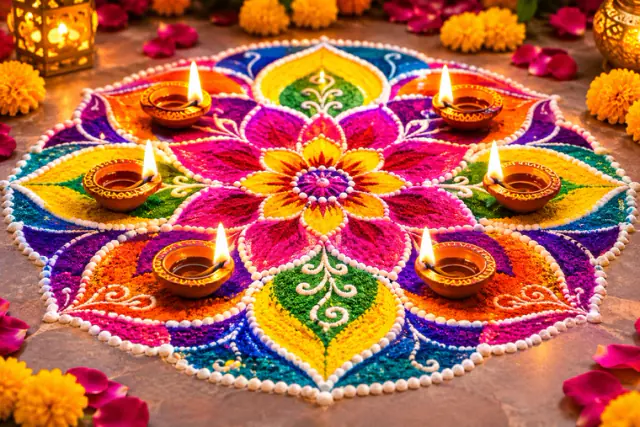
A rangoli takes hours to make and is often swept away the next day, so a good photo is the best way to keep it. Rangoli is also surprisingly tricky to photograph: it lies flat on the floor, it is big, and it is often lit by flickering diyas at night. These 12 phone tips will help you capture its colours and symmetry, whether it is your own rangoli, your family's or one you saw at a temple or market.
In this article
Rangoli, kolam and pookalam
Floor art goes by many names across India and beyond. Rangoli usually means designs made with coloured powder, rice or flower petals, especially for Diwali. Kolam in Tamil Nadu is drawn each morning with rice flour, often in white lines around a grid of dots. Pookalam in Kerala is made from flower petals for Onam. In Maharashtra and elsewhere, many homes make rangoli at the doorstep for festivals and weddings.
All of them share the same challenges for a photo: they are flat, round or symmetrical, and best seen from above.
Shoot from above, and keep it round
- Get as high as you safely can. Stand on a sturdy chair, a step or a stair, or photograph from a balcony above. Never lean over a railing or stand on anything wobbly.
- Hold the phone flat and level, parallel to the floor. If the phone is tilted, a circle turns into an oval. Many phones show a crosshair or level guide when you point straight down: line it up.
- Use the ultra-wide (0.5x) lens if you cannot get high enough to fit the whole rangoli. Keep it in the middle of the frame, where the ultra-wide lens bends lines the least.
- Leave a little space around the edge. A thin border of floor makes the design feel complete; cutting off a petal makes it feel broken.
Tip: Turn on your camera's grid lines. Put the centre of the rangoli where the two middle lines cross, and use the outer lines to check it is not tilted.
Light: daylight or diyas
- For true colours, shoot in soft daylight. Morning or late afternoon light, or open shade, shows powder colours exactly as they are. Avoid harsh midday sun, which makes hard shadows of every grain.
- Watch your own shadow. When you stand over a rangoli, your shadow often falls across it. Stand with the light coming from the side, or shoot from the shady side.
- For the festive glow, shoot at dusk with the diyas lit. The blue hour, just after sunset, gives a little light to the design while the diyas sparkle. Tap on a bright part and slide the brightness down slightly so the flames keep their shape. Our night photography guide explains more.
- Avoid the flash. It flattens the colours and makes powder look chalky.
Details and the making of
- Take close-ups of texture. Get close to the edge where two colours meet, the grains of powder, a flower petal or a diya flame. Close-ups often show the craft better than the full view.
- Photograph the making. Hands pouring a thin line of powder, a cone of colour, a stencil being lifted: these photos tell a story and are often the most liked. If you include people, make sure adults are happy to appear and children's faces are not visible.
- Add context at an angle. A low, angled photo with the rangoli in front and a decorated doorway, lamps or the family's feet behind tells viewers where and why it was made.
- Shoot it before anyone walks on it. Rangolis smudge fast. Take your photos first thing, and again when the diyas are lit.
Edit lightly
Straighten and crop so the design sits in the centre, lift brightness slightly if the photo is dark and correct any orange colour cast from bulbs. Do not boost saturation too far: rangoli colours are already strong, and overdoing it makes them glow unnaturally. Our guide to phone photo editing explains each step.
Entering the Rangoli contest
Share2Earn's free Rangoli photo contest runs through November 2026. Enter a photo of a rangoli you made or saw this month: powder, flowers, rice or diyas. Kolam and pookalam count too. The photo must be taken by you during November 2026, and you can enter one photo per topic.
- Only light edits are allowed: crop, rotate, brightness, contrast and colour. No AI-generated or AI-edited images, collages, borders, watermarks or text.
- Adults in your photo must have agreed to appear, and children's faces must not be recognisable.
- The photo with the highest engagement score wins, so share your entry with family and friends who saw the rangoli being made.
Looking for more festival ideas? See our 25 Diwali photography ideas.
Questions
How do I take a photo of a rangoli from above?
Stand safely on a sturdy chair, step or balcony, hold the phone flat and level over the centre of the design and use the grid lines to keep it straight. If you cannot get high enough, use the 0.5x ultra-wide lens and keep the rangoli in the middle of the frame.
Why does my rangoli look like an oval in photos?
The phone is tilted. Hold it exactly parallel to the floor, directly above the centre of the rangoli. Many phones show a level guide when you point straight down.
What is the best time to photograph a rangoli with diyas?
Just after sunset, during the blue hour. There is still a little daylight to show the colours of the rangoli, and the diyas glow brightly.
Can I enter a kolam or flower rangoli in the contest?
Yes. The Rangoli topic includes floor designs made of coloured powder, rice flour, flowers or lamps, including kolam and pookalam, as long as you took the photo yourself in November 2026.
Enter the Rangoli photo contest
Free for everyone 18+, worldwide. Entries open 7 November and close 25 November. Real photos taken by you this month only.
See the contest →