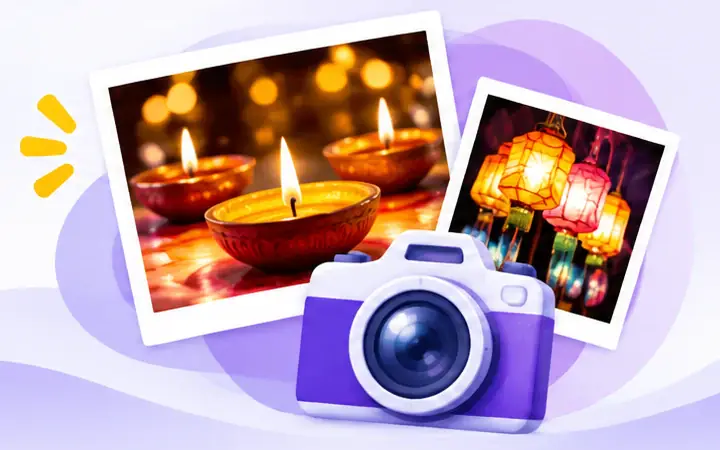
Festivals of Lights Around the World: Diwali, Loy Krathong, Hanukkah and More
By the Share2Earn team · · 5 min read
Across cultures and continents, people light lamps, candles and lanterns in the darkest months of the year. The stories are different — victory, freedom, gratitude, hope — but the image is the same: small lights pushing back the night. Here are 12 festivals of lights, what they celebrate, and what makes each one special to photograph.
In this article
South Asia
1. Diwali (India and the Indian diaspora)
Diwali, from the Sanskrit Deepavali — "row of lights" — is celebrated over five days, with the main night falling on the new moon of the Hindu month of Kartik, in October or November. In much of north India it marks Lord Rama's return to Ayodhya after defeating Ravana; in the south it is linked with Krishna's victory over the demon Narakasura. Homes are cleaned, rangoli is drawn at the door, clay diyas line every edge, and families worship Lakshmi, the goddess of wealth. The five days run from Dhanteras to Bhai Dooj, when sisters pray for their brothers.
Photograph: rows of diyas, rangoli from above, the aarti plate in motion, sweets by lamplight. See our 25 Diwali photography ideas.
2. Bandi Chhor Divas (Sikh)
On the same day as Diwali, Sikhs celebrate Bandi Chhor Divas, the "day of liberation", remembering Guru Hargobind's release from Gwalior Fort along with 52 imprisoned kings. The Golden Temple in Amritsar is lit with lamps and fireworks reflect in its sacred pool.
3. Diwali for Jains
For Jains, Diwali marks the nirvana (moksha) of Lord Mahavira, the 24th Tirthankara, at Pavapuri in Bihar. Lamps symbolise the light of knowledge that remains after his passing.
4. Tihar (Nepal)
Nepal's five-day Tihar honours animals as well as gods: crows on the first day, dogs on the second (Kukur Tihar, when dogs are garlanded and given treats), and cows on the third, which is also Lakshmi Puja. It ends with Bhai Tika, when sisters place a colourful seven-colour tika on their brothers' foreheads.
Photograph: garlanded dogs and marigolds make joyful, colourful photos — ask the owner first.
5. Dev Deepawali (Varanasi)
On Kartik Purnima, the full moon about two weeks after Diwali, the ghats of Varanasi along the Ganga are lit with hundreds of thousands of diyas — the "Diwali of the gods". The river reflects the lamps for kilometres, and boats crowd the water to watch the Ganga aarti.
Photograph: from a boat at blue hour, with the steps of the ghats leading the eye.
6. Karthigai Deepam (Tamil Nadu)
Celebrated on the full moon of the Tamil month of Karthigai, this ancient festival is famous for the huge Maha Deepam lit on top of the Arunachala hill at Thiruvannamalai, visible for miles. Homes are decorated with rows of agal vilakku (clay lamps).
South-East and East Asia
7. Loy Krathong and Yi Peng (Thailand)
On the full moon of the twelfth month of the Thai lunar calendar — usually in November — people float krathongs, small baskets made from banana leaves and decorated with flowers, candles and incense, on rivers and lakes to thank the water goddess and let go of bad luck. In Chiang Mai, the Yi Peng festival at the same time fills the sky with paper lanterns.
Photograph: a single krathong with its reflection, or hands releasing it onto the water.
8. Lantern Festival (China and beyond)
The Lantern Festival falls on the 15th day of the first lunar month and closes the Chinese New Year celebrations. Streets fill with red lanterns, riddles are written on lanterns for visitors to solve, and families eat tangyuan (sweet rice dumplings).
9. Vesak lanterns (Sri Lanka)
During Vesak, which celebrates the birth, enlightenment and passing of the Buddha, Sri Lankan towns are decorated with handmade lanterns and huge illuminated pandals telling stories from the Buddha's life.
Europe, the Middle East and the Americas
10. Hanukkah (Jewish)
Hanukkah lasts eight nights and remembers the rededication of the Second Temple in Jerusalem, when — according to tradition — a small amount of oil burned for eight days. Each night, one more candle is lit on the menorah (hanukkiah), which has nine branches: eight for the nights and one for the shamash, the helper candle used to light the others.
11. St Lucia's Day (Sweden and Scandinavia)
On 13 December, in the darkest weeks of the northern winter, a girl in a white gown with a crown of candles leads a procession of singers. Saffron buns called lussekatter are shared with coffee.
12. Fête des Lumières (Lyon, France)
Around 8 December, the people of Lyon place candles in their windows to thank the Virgin Mary, a tradition dating back to 1852. Today it is also a city-wide light art festival with projections on famous buildings.
Also look out for: the seven candles of the kinara during Kwanzaa (26 December to 1 January) and Christmas lights, which fill streets around the world in December.
Tips for photographing any festival of lights
- Respect first. These are religious and family occasions. Ask before photographing people at prayer, don't use flash during ceremonies, and follow the rules of temples, gurdwaras and synagogues.
- Arrive before dark. Find your spot while you can still see, then shoot as the sky turns deep blue.
- Look for one human detail — a hand, a face lit from below, a child's reaction — among the many lights.
- Keep the phone steady and lower the exposure so each flame keeps its shape. Our night photography guide explains how.
Whatever festival of lights you celebrate this November, you can enter it in our free Festival of Lights photo contest — lamps, candles, lanterns or festive lights from your own celebration, taken in November 2026.
Questions
Which festival is called the Festival of Lights?
Diwali is most often called the Festival of Lights, but many cultures have one: Hanukkah, Loy Krathong, the Lantern Festival, St Lucia's Day, Dev Deepawali and Karthigai Deepam among them.
What does Diwali mean?
Diwali comes from the Sanskrit word Deepavali, meaning "row of lights" — from the rows of clay lamps (diyas) lit on the festival night.
When is Loy Krathong?
Loy Krathong is held on the full moon of the twelfth month of the Thai lunar calendar, which usually falls in November.
Enter the Festival of Lights photo contest
Free for everyone 18+, worldwide. Entries open 7 November and close 25 November. Real photos taken by you this month only.
See the contest →